
In short
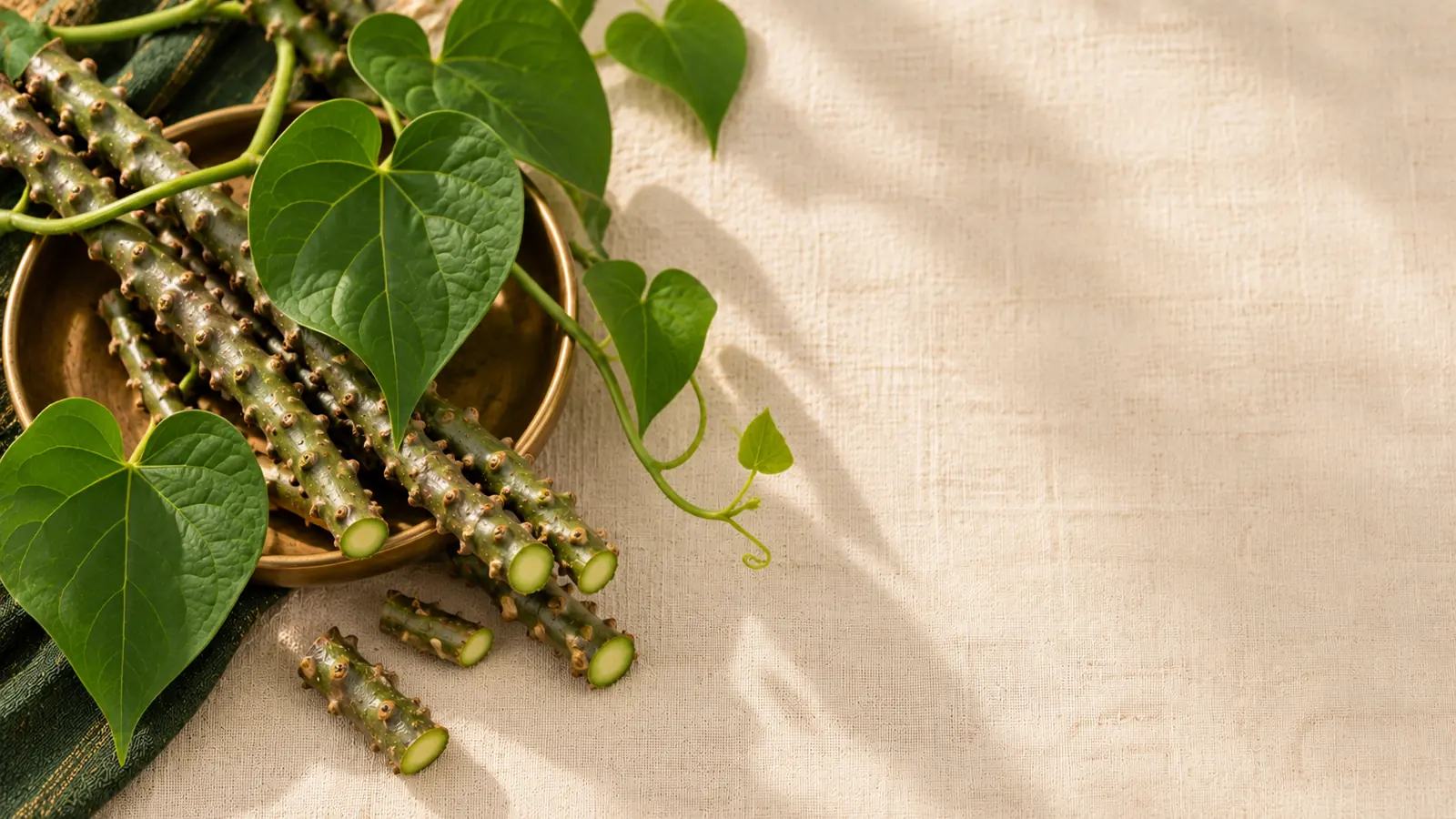
Giloy — known in Sanskrit as Guduchi (Tinospora cordifolia) — is the very herb our clinic takes its name from. It is one of Ayurveda's most respected rasayana (rejuvenating) herbs, traditionally valued for metabolic balance and overall vitality. Here we explain how it is used, how to use it safely, and why it belongs alongside — not in place of — your medical care.
Introduction
There is a reason our clinic is called Guduchi. In classical Ayurveda, Guduchi is affectionately named Amrita — "the nectar of immortality" — a reflection of how highly generations of physicians regarded this humble climbing vine. You may know it by its common name, Giloy. It grows readily across India, and its heart-shaped leaves have been part of household and clinical Ayurveda for centuries.
Let us be clear and calm about what that means. Guduchi is a traditional herb valued for supporting the body's balance and resilience; it is not a medicine that treats or controls diabetes. Within the Ayurvedic view of Prameha — the broad family of metabolic imbalances — Guduchi is one of several herbs traditionally used to support healthy metabolism as part of a wider lifestyle approach.
Want to understand how our namesake herb fits a personalised plan? Book a consultation with our Ayurvedic doctor →
Why Ayurveda values Guduchi
Guduchi is classed among the rasayana herbs — those traditionally used to nourish the tissues, support digestion (agni) and build steady vitality. It carries a bitter (tikta) and astringent taste, qualities Ayurveda associates with pacifying excess Kapha and Pitta. Because impaired agni and Kapha accumulation sit at the heart of how Ayurveda understands metabolic imbalance, a bitter, balancing herb like Guduchi has long been included in supportive care for Prameha.
This is a traditional framework, refined through centuries of clinical observation rather than laboratory measurement. Its enduring value is that it directs attention toward digestion, immunity and daily balance — the everyday foundations of metabolic wellbeing.
How Guduchi is traditionally used
Guduchi appears in Ayurveda in several forms:
- The fresh stem, considered especially potent in classical texts.
- Dried stem powder, used in many traditional formulations.
- Satva — a starchy extract prepared from the stem — used in classical preparations.
These forms are chosen and combined by a physician according to the individual's constitution (prakriti) and current state. In an Ayurvedic clinic, Guduchi is rarely used in isolation; it is usually one considered part of a thoughtfully balanced blend.
How to use it safely
"Natural" does not automatically mean "safe for everyone" — and Guduchi is no exception, however gentle its reputation.
- Do not self-prescribe Giloy powders, juices or tablets bought off the shelf as a way to manage blood sugar.
- Herbs can interact with medicines. Taken alongside blood-sugar-lowering medication without supervision, some preparations may affect your levels unpredictably.
- Use only under a qualified physician's guidance, who can judge the right form, quality and combination for you.
- Never treat Guduchi as a replacement for prescribed medication or for your regular blood-sugar monitoring.
- If you have an autoimmune condition, liver concerns, are pregnant, elderly, or managing other conditions, speak to your doctor before using any Guduchi preparation.
Not sure which preparation suits you? Book a consultation with our doctor →
How it fits alongside your care
At Guduchi, we hold our namesake herb in genuine respect — and precisely because of that respect, we use it responsibly. Guduchi is one supportive element within a much larger picture of diet, daily routine (dinacharya) and stress care. The medical management of your diabetes — diagnosis, medicines and monitoring — remains firmly with your treating doctor. Ayurveda works around that treatment, helping you build steady, sustainable habits.
Two hands, working together: your physician manages the medical side, while an Ayurvedic doctor helps you strengthen your daily foundations.
Key takeaways
- Guduchi (Giloy) is our namesake herb, a classical rasayana traditionally valued in Ayurveda for metabolic balance and vitality.
- It is used as fresh stem, powder or satva — always chosen and combined by a physician, not self-prescribed.
- "Natural" is not automatically safe; herbs can interact with medicines, so use only under guidance.
- Guduchi supports a balanced lifestyle; it does not replace medication, medical advice, or blood-sugar monitoring.
Frequently asked questions
Q. Is Giloy the same as Guduchi? A. Yes. Giloy is the common Hindi name and Guduchi the Sanskrit name for the same herb, Tinospora cordifolia. It is the plant our clinic is named after.
Q. Can I stop my diabetes medicines if I take Giloy? A. No. You should never stop or change prescribed medication. Guduchi is used here as supportive care alongside your medical treatment, never as a replacement.
Q. Is it safe to buy Giloy supplements and take them myself? A. It is best not to self-prescribe. Quality varies, and preparations can interact with medicines or affect your blood sugar. Use Guduchi only under a qualified physician's guidance.
Next steps with Guduchi
Terms in this article
Explore the Ayurveda glossary or try our free diabetes risk score.
Ayurvedic diabetes care near you
Guduchi Ayurveda runs BAMS-led clinics in eight Indian cities. Reading is a start — a physician who sees your reports can tailor it to you.
- Ayurvedic Diabetes Clinic, AhmedabadSola, Ahmedabad
- Ayurvedic Diabetes Clinic, BangaloreBanaswadi, Bangalore
- Ayurvedic Diabetes Clinic, ChennaiAnna Nagar West, Chennai
- Ayurvedic Diabetes Clinic, DavangereDavangere
- Ayurvedic Diabetes Clinic, HubballiVidya Nagar, Hubballi
- Ayurvedic Diabetes Clinic, HyderabadJubilee Hills, Hyderabad
- Ayurvedic Diabetes Clinic, KalaburagiShastri Nagar, Kalaburagi
- Ayurvedic Diabetes Clinic, KolkataNewtown, Kolkata
- Ayurvedic Diabetes Clinic, MangaluruUrwa, Mangaluru
- Ayurvedic Diabetes Clinic, MysuruKuvempunagar, Mysuru
- Ayurvedic Diabetes Clinic, UdupiBrahmagiri, Udupi
See all Guduchi diabetes clinics · Book an online consultation
DY
Written by
Dr. Yamuna B SBAMS — Senior Ayurvedic Physician · Bengaluru, Karnataka · Reg. No. 22157
Dr. Yamuna B S is a Senior Ayurvedic Physician at Guduchi Ayurveda in Bengaluru, with a deep focus on Madhumeha (the Ayurvedic understanding of diabetes) and lifestyle-led metabolic care. She works closely with each patient to combine classical Ayurvedic principles with practical, day-to-day guidance on diet, routine and stress — always alongside, not in place of, their regular medical care.
Medical disclaimer: This article is for general education and is not a substitute for professional medical advice, diagnosis, or treatment. Ayurveda is described here as a supportive, complementary system. Do not stop or change any prescribed medication without consulting your treating physician. Always speak with a qualified doctor about your individual health, especially if you are pregnant, elderly, or managing other conditions.